
Grip strength and balance are simple measures that can reveal more about long-term health than many people realise. They do not diagnose disease or determine how long someone will live, but they can provide useful information about strength, coordination, physical reserve and functional ageing.
Why grip strength matters
Grip strength is one of the strongest simple predictors of longevity and functional ageing. Yet it is rarely included in routine health assessments.
The large Prospective Urban Rural Epidemiology (PURE) study found that lower grip strength was associated with increased all-cause and cardiovascular mortality. In that study, grip strength was a stronger predictor of all-cause and cardiovascular mortality than systolic blood pressure.
This does not mean that a weak grip causes early death, or that grip strength is more important than blood pressure in clinical care. It means that a quick functional measure can capture information about health and physical reserve that conventional risk factors may not fully show.
It is not really about grip
Grip strength is useful because it can act as a proxy measure for several aspects of health and ageing, including:
- Overall muscle strength and physical function.
- Neuromuscular integrity.
- Physical reserve and resilience.
- Frailty and functional-ageing risk.
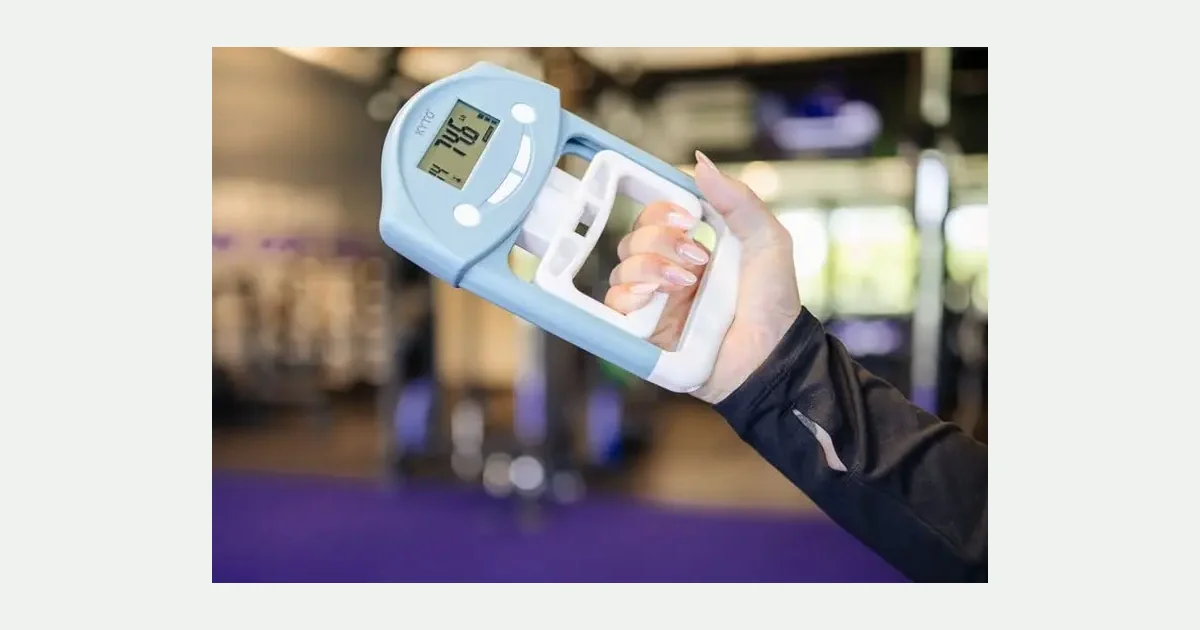
It takes less than 30 seconds to assess with a hand dynamometer. The result should be interpreted in context, because grip strength varies with age, sex, body size, hand dominance, pain, injury, arthritis, neurological conditions and the testing method used.
A single result is not a diagnosis. It is most useful when compared with appropriate reference values and considered alongside muscle mass, mobility, medical history and other functional measures.
Grip strength and brain health
The association extends beyond physical health. UK Biobank research involving approximately 466,000 participants found that lower grip strength was associated with a higher incidence of dementia and dementia-related mortality.
Again, this is an association rather than proof that increasing grip strength alone will prevent dementia. Grip strength may partly reflect broader factors such as physical activity, general health, vascular health, neurological function and the effects of ageing.
Measuring capacity before it is lost
One limitation of conventional medicine is that we often focus heavily on disease detection while paying less attention to functional decline occurring years earlier. Grip strength can contribute to a broader assessment of:
- Accelerated loss of strength or muscle function.
- Reduced physiological reserve.
- Frailty risk.
- Early decline in overall resilience.
Preventative medicine should not only identify disease. It should also measure capacity before decline becomes difficult to reverse.
What a 10-second balance test may reveal
A simple 10-second balance test may also reveal more about long-term health than most people realise.
Research published in the British Journal of Sports Medicine followed 1,702 adults aged 51–75. Those who could not complete a 10-second one-legged stance had a substantially higher risk of death during the median seven-year follow-up, even after the researchers accounted for several other health factors.
This observational result does not establish that poor balance causes early death. The test is better understood as a broad marker of health and function rather than a prediction for any individual.
Balance relies on multiple systems
Balance reflects the function of multiple systems working together:
- Vision.
- Inner-ear and vestibular function.
- Muscle strength.
- Coordination and reaction time.
- Neurological health.
- Proprioception and spatial awareness.
In other words, balance is not just about avoiding falls. It can be a useful marker of overall physical resilience. Poor balance can also become more consequential with age because falls may lead to injury, loss of confidence and reduced independence.
Strength and balance can often be improved
The encouraging part is that strength and balance often respond to training. Appropriate interventions may include:
- Resistance training with progressive loading.
- Regular balance and coordination exercises.
- Maintaining muscle mass with age.
- Reducing prolonged inactivity and physical deconditioning.
- Addressing vision, medication, footwear or medical issues that affect stability.
Current Australian physical activity guidance for older adults recommends muscle-strengthening activity on at least two days each week and functional activities targeting mobility, balance and coordination on at least three days. Exercise should be matched to the individual’s health, ability and falls risk.
Can you try the balance test yourself?
If you are steady on your feet, you might notice how comfortably you can stand on one leg for 10 seconds while near a stable support. However, a home test is not a substitute for clinical assessment, and the published study used a specific standardised procedure.
Do not attempt an unsupported balance test—or close your eyes while balancing—if you have a history of falls, dizziness, significant weakness, impaired sensation, poor vision or another condition that could make the test unsafe. Seek advice from an appropriate health professional instead.
The bottom line
Grip strength and balance are not measures of health in isolation. They are useful, quick indicators of functional capacity that can add context to a broader preventative health assessment. Sometimes the simplest tests provide surprisingly valuable information.
References
- Leong DP, Teo KK, Rangarajan S, et al. Prognostic value of grip strength: findings from the Prospective Urban Rural Epidemiology (PURE) study. View source .
- Esteban-Cornejo I, Ho FK, Petermann-Rocha F, et al. Handgrip strength and all-cause dementia incidence and mortality: findings from the UK Biobank prospective cohort study. View source .
- Araújo CGS, de Souza e Silva CG, Laukkanen JA, et al. Successful 10-second one-legged stance performance predicts survival in middle-aged and older individuals. View source .
- Australian Government Department of Health, Disability and Ageing. Recommendations for older adults (65 years and over). View source .